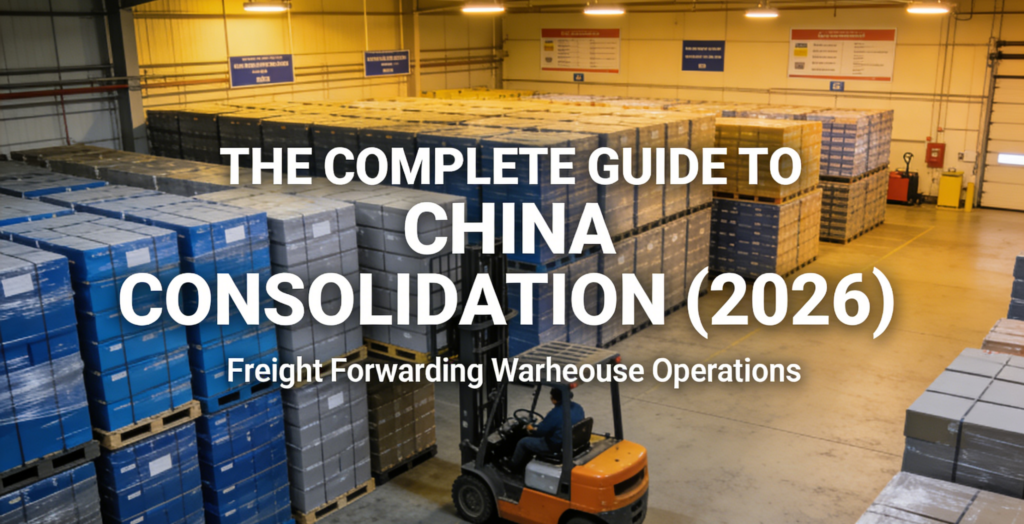
Sourcing from multiple suppliers in China but struggling with freight costs and LCL minimum charges? If you’re in this situation—shipping goods from different suppliers—you know the pain: multiple freight bills, high handling fees, and customs headaches.
Good news: China consolidation can help. In this guide, we’ll walk you through:
- The full consolidation process
- Real cost breakdowns
- 8 critical mistakes most beginners make
Let’s get started.
What is China Consolidation?
Definition
China Consolidation (also called groupage shipment or LCL consolidation) is the process of combining shipments from multiple Chinese suppliers into a single container or LCL (Less than Container Load) before exporting to the final destination.
Example: You need to ship 7 small boxes from 7 different factories. Instead of 7 freight bills and 7 customs clearances, you send them all to a consolidation warehouse—where they’re combined into one efficient shipment.
Who Needs China Consolidation Services?
Let’s be honest—China consolidation isn’t for everyone. But if any of these sound like you, it might be the best logistics decision you’ll make this year.
E-commerce Sellers
Whether you’re on Amazon, Shopify, eBay, or building your own DTC brand, you’re likely sourcing from multiple suppliers and restocking in small batches to avoid tying up capital. The problem? Shipping each order separately means paying LCL minimum charges over and over. Consolidation pulls everything into one shipment—so your FBA inventory stays stocked, your dropshipping runs smoothly, and your freight costs actually make sense.
Traditional Importers
Dealing with multiple suppliers and drowning in paperwork? One consolidated shipment means one customs clearance, one tracking number, and way less headache.
Overseas Warehouse Users
Tired of paying receiving fees over and over? Consolidation gets everything on one pallet—one fee, one delivery, no confusion.
Project Cargo
Multiple suppliers sending materials to your job site? If they arrive weeks apart, your crew stands around with nothing to do—but you’re still paying them. Consolidation makes sure everything shows up at the same time.
Startups
Testing the market with small orders of multiple products? Shipping separately would cost more than the goods themselves. Consolidation lets you start small without huge risk.
Crowdfunding Campaigns
Backers worldwide waiting for products made by different factories? Consolidation means unified QC, complete units, and one streamlined global shipment.
Furniture Importers
Tables from one factory, chairs from another, sofas from a third? Consolidation lets you mix and match SKUs into one container, optimizing space and inventory.
Who Doesn’t Need It?
As we said before: consolidation is great, but not for everyone. Here’s who can probably skip it:
Single-Source Importers
One supplier, one shipment, one set of documents. No need to consolidate what’s already together.
Full Container Load (FCL) Shippers
Ordering >15 CBM from a single supplier? Book a full container. It’s cheaper per unit and simpler.
Ultra-Urgent Shipments
Need it fast? Consolidation isn’t your friend. You’re waiting for other suppliers to deliver—that takes days, sometimes weeks. If you’re in a hurry, ship by air.
Dangerous Goods / Batteries / Liquids
Most consolidation warehouses won’t touch DG cargo. Too much liability. You need specialized handlers.
Still wondering if it’s for you? Reach out for a free, tailored consultation. We’ll tell you if consolidation makes sense—and be honest if it doesn’t.
China Consolidation Process: Step-by-Step Guide
Ready to give consolidation a try—or not sure where to start? Let’s walk through it together.
Step 1: Place Orders with Suppliers
You order from multiple factories. Each gets ready to ship their part.
Just make sure: You know when each supplier can deliver.
Step 2: Pick a Consolidation Warehouse
Choose a warehouse where all your suppliers will send their goods.
We can help with this—just ask.
Step 3: Suppliers Ship to the Warehouse
Each supplier sends their goods to the same warehouse. Some arrive early, some late—that’s normal.
Your job: Stay in touch with late suppliers.
Step 4: Warehouse Checks Everything In
As boxes arrive, the warehouse:
- Counts everything
- Takes photos
- Lets you know what’s there
- You’ll get a report so you know nothing’s missing.
Step 5: Wait for All Goods
Now you wait until all suppliers have delivered. The warehouse holds everything until it’s all there.
Heads up: We give you free storage for the first few days—so no stress if one supplier is a little late.
Step 6: Combine Everything into One Shipment
Once everything’s in, the warehouse:
- Puts all goods together
- Builds stable pallets
- Wraps them tight for shipping
- Labels everything
- You’ll get photosof your pallets before they ship.
Step 7: Ship It Out
The warehouse hands your consolidated pallets to your freight forwarder (or they can recommend one).
Then it heads to you—by sea or air.
One shipment. One tracking number. One customs clearance.
Step 8: Receive Your Goods
Your goods arrive at your door. Everything together. One delivery. One set of papers.
That’s it. Instead of chasing 7 different shipments, you just handle one.
Cost Breakdown – What You're Really Paying For China Consolidation?
Let’s talk money. Here’s a breakdown of typical fees you’ll encounter with China consolidation—so you know what to expect and what questions to ask.
Fee Structure Table
Fee Item | What it covers | Typical Range | When It Applies | |
Receiving Fee | Unloading, counting, inspecting goods when they arrive | $7–20 per supplier shipment | Each time a supplier delivers to warehouse | |
Warehousing | Holding your goods until all suppliers arrive | Free for first 3–7 days, then $0.70–2.80 per CBM per day | After free storage period ends | |
Handling Fee | Moving goods, organizing, preparing for consolidation | $11–28 per CBM | Once, based on total volume | |
Palletizing | Building pallets, stretch wrap, materials | $7–21 per pallet | Per pallet created | |
Stretch Wrapping | Wrapping pallets with plastic film for protection | $3–8 per pallet | Per pallet, optional but recommended | |
Inspection Report | Photos + carton count report per supplier | $5–15 per shipment | Per consolidation, covers reporting | |
Documentation Fee | Master packing list, combined paperwork | $14–42 per shipment | One-time fee per consolidation | |
Cargo Insurance | Protection against loss/damage during transit | 0.1–0.3% of cargo value | Optional, calculated based on total value | |
Loading Fee | Loading onto forwarder’s truck, handover documents |
| When goods leave warehouse |
Hidden Fee Traps in China Consolidation Services
The quote looks fair. Then the invoice arrives with extras. Here’s what often catches people off guard.
1. Minimum Volume Charge
What it is: You’re quoted $20/CBM, but there’s a “minimum 3 CBM” charge in the fine print. You ship 1.5 CBM but pay for 3.
Ask this: “Is there a minimum CBM charge? If my shipment is under that, what do I actually pay?”
2. Storage Clock Starts Early
What it is: Free storage is “3 days.” But the clock starts when the first box arrives, not the last. Supplier A delivers Monday, Supplier B Friday—you pay storage Thursday and Friday on all goods, even while waiting.
Ask this: “When does free storage start? From first delivery or after all goods are in?”
3. Pallet Deposit That Never Comes Back
What it is: You pay a “refundable” deposit for pallets—$20 each. Shipment leaves. Deposit doesn’t come back.
Ask this: “Is there a pallet deposit? When and how is it refunded?”
4. Double Charging: Receiving + Handling
What it is: You’re charged a “receiving fee” when goods arrive, and a “handling fee” later—for basically the same work.
Ask this: “What’s the difference between receiving fee and handling fee? Do I need both?”
A good quote isn’t just cheap—it’s complete. If something feels missing or too vague, ask. The fees not mentioned upfront are usually the ones that show up later.
How to Save Costs
With consolidation, a few simple moves can make a real difference. Here are three proven ways to keep costs down.
1. Get All Suppliers Delivered Within Free Storage Days
Most warehouses give you 3–7 days free. After that, you pay daily.
The trick: Give suppliers a fake deadline—a few days earlier than the real one. If someone’s late, you’re not paying extra.
2. Bring Your Own Pallets
Warehouses charge $10–20 per pallet. That adds up.
The trick: If you have standard pallets, use them. Ask the warehouse first—if they say yes, you just saved $20 a pop.
3. Ship Fewer Times
Every shipment means fees: receiving, docs, minimum charges.
The trick: Wait until you have more to ship. Instead of sending small batches, combine them. One bigger shipment costs way less than several small ones.
8 Critical Pitfalls to Avoid in China Consolidation
Even experienced importers make mistakes. Here are the most common ones—and how to avoid them.
Pitfall 1: Suppliers Deliver Whenever They Want
You ask all suppliers to deliver by Friday. One arrives on time. Another shows up the following Tuesday. A third? No idea when they’ll show up.
Meanwhile, the warehouse starts charging storage fees on all your goods while you wait.
The Fix: Give suppliers a deadline that’s 3–5 days earlier than your actual cutoff. So that you can have more buffer. Also, check in with them regularly as the date approaches.
Pitfall 2: The Quote Looks Cheap, But the Final Bill Is Much Higher
You get quoted $15/CBM—sounds reasonable. Then the invoice arrives with extra charges: receiving fee, documentation fee, pallet fee. Fees you never knew existed.
The fix: Before committing, ask for a complete list of all possible fees. Get everything in writing.
Pitfall 3: You Don’t Realize Something’s Missing Until It’s Too Late
Supplier A sends fewer items than ordered. Supplier B sends extra. Nobody notices until the goods arrive at your door—and by then, it’s too late to fix.
The fix: Request a receiving report with photos for every supplier delivery. Check against your orders. Do this before consolidation starts.
Pitfall 4: Pallets Arrive Damaged or Poorly Stacked
Bad palletizing leads to crushed boxes, broken products, and insurance claims. Sometimes the whole pallet collapses during transit.
The fix: Ask for photos after palletizing. Check for boxes hanging over the edge, unstable stacking, and proper wrapping. If it doesn’t look right, ask them to redo it.
Pitfall 5: Handover Disputes—Warehouse Says Shipped, Forwarder Says Never Received
The warehouse claims they loaded your goods onto the truck. The forwarder says the truck arrived empty. You’re caught in the middle.
The fix: Require a signed handover document with timestamped photos at the transfer point. Proof protects everyone.
Pitfall 6: The Warehouse Lacks Export Authorization
Your goods are ready to ship, but customs blocks them—because the warehouse isn’t licensed for export. Now you’re stuck.
The fix: Verify the warehouse has a valid import/export license before sending anything. Or use a forwarder-bonded warehouse.
Pitfall 7: Miscommunication Leads to Mistakes
A quick WeChat message says “label the boxes.” But which labels? Which boxes? Details get lost. Mistakes happen.
The fix: Use standardized forms for all instructions: delivery addresses, shipping marks, carton counts. Put everything in writing. Confirm with photos.
Pitfall 8: You Went with the Cheapest Option and Regret It
The warehouse was $50 cheaper than others. Great! Until they stopped replying to messages and your goods sat for a week.
The fix: Price matters—but so does service. Check response times. Ask for references. Read reviews. Paying a little more often saves a lot of trouble.
Most of these pitfalls are avoidable. A few simple steps—photos, written confirmations, clear deadlines—can save you time, money, and stress.
Remember: The goal isn’t just to ship. It’s to ship without surprises.
FAQ – Quick Answers
Q1: Is consolidation worth it for small shipments (<3 CBM)?
A: Yes, but watch out for minimum volume charges. Some warehouses bill for 3 CBM even if you only ship 1. Look for warehouses with no CBM minimum.
Q2: How to avoid overtime storage fees?
A: Set a firm cutoff date for suppliers, add a 3-day buffer, and follow up daily as the deadline approaches.
Q3: Do I need cargo insurance for consolidated shipments?
A: Strongly recommended. Consolidation involves more handling points than full containers, which means higher risk of damage or loss.
Ready to Get Started?
Still have questions about China consolidation? Not sure if it’s right for your business?
We’re here to help. Whether you need a quick quote or a full walkthrough of the process, just reach out.
No pressure. No tricks. Just straight answers.
About Quacn
Quacn is a professional China consolidation service provider. Unlike traditional forwarders who often handle single shipments, we specialize in collecting shipments from multiple suppliers across China, consolidating them into one cost-effective shipment, and providing value-added services like repacking and inspection. We are your one-stop logistics solution for cross-border e-commerce.